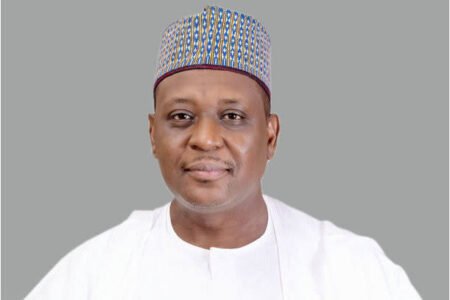


The Minister of Communication and Digital Economy, Prof. Isa Pantami, has expressed worry over the growing rate of cyber-attacks across the globe, especially in Nigeria.
Pantami said this at the opening of a two-day International Workshop on Cyber-security and Digitalisation, organised by the Africa Centre of Excellence on Technology Enhanced Learning (ACETEL), technology unit of the National Open University of Nigeria (NOUN).
The workshop is being organised by ACETEL in partnership with the Economic and Financial Crimes Commission (EFCC), National Information Technology Development Agency (NITDA) and CEA-SMIA.
Represented by Prof. Sahalu Junaidu, the minister said that more malware were being launched on daily basis, more than ever before.
Malware is a software that is specifically designed to disrupt, damage or gain unauthorised access to a computer system.
“The resulting damages of cyber-attacks are not only increasingly, but are unfortunately projected to cost the loss of approximately 5.2 trillion dollars across the globe by 2023.

Explaining cyber-attacks common in Nigeria, he said, “Cybercrime is one of the challenges resulting from the internet and is a great threat to the global economy.
“Cyber-security ventures expects global cybercrime costs to grow by 15 per cent per year over the next five years, reaching 10.5 trillion dollars annually by 2025, up from 3 trillion dollars in 2015.
“This represents the greatest transfer of economic wealth in history and is one of the greatest transfer risks against the drive for innovation and investment,” he said.
According to Pantami, Nigeria, Kenya and South Africa record the largest losses to cyber-attacks as at 2017.
The minister quoted a Kenya-based cyber-security IT firm, Serianu, as saying that African economies lost about 3.5 billion dollars to cybercrimes as at 2017.
“In that year, annual losses to cybercrimes were estimated for Nigeria at 649 million dollars, and Kenya at 210 million dollars, while South African Banking, Risk Information Centre (SABRIC), said South Africa lost approximately 157 million dollars”.
Pantami also said that the increase in cybercrimes was due to the outbreak of COVID-19 which inspired a global adoption of digital platforms.
The Vice Chancellor of NOUN, Prof. Olufemi Peters, said time had come for every Nigerian citizen to be digitally enabled to reduce cyber risks as cyber-security was considered to be the cornerstone of successful digital transformation initiatives.
“The Digital Economy Initiative for Africa (DE4A) has advocated that every citizen, company and government in Africa must be digitally enabled by 2030 in support of the African Union’s ‘Digital Transformation Strategy for Africa’.
“This is in recognition that digital technologies present a unique opportunity for rapid economic growth, innovation, job creation and access to services unimaginable only a decade ago.
“There is no doubt that complex cyber-attack in educational, governmental and industrial settings pose a big threat to smooth growth and efficient business processes.
“Criminals exploit the fact that many industrial machines as well as simple devices (e.g., TVs, smartphones, PCs and servers) are increasingly software-controlled and connected to the Internet.
“Unfortunately, many of these devices lack regular security updates and are very vulnerable; cybercriminals try to gain access to the software of these devices so as to conduct Distributed Denial of Service (DDoS) attacks,” Peters said.
He explained that the consequences of a successful cyber-attack can be devastating for companies and businesses as it could lead to bankruptcy.
Also speaking, Prof. Grace Jokthan, the Director, ACETEL, said the workshop could not have some at a better time as Africa and the globe strive to achieve a high level of efficiency on digitalisation.
She urged governments and citizens to be committed to understanding the risk of cyber threats and adhere to cyber security policies.
“We all need to equip ourselves with the needed cyber-security strategies to sustain the on-going digital transformation,” Jokthan said.
The Chairman of the EFCC, Mr Abdulrasheed Bawa, in his keynote address said several organisations were quick to embrace digital transformations without putting adequate cyber-security policies and strategy in place.
Bawa, who was represented by Mr Bello Mohammed, the Director of ICT, EFCC, noted that cyber-security policies had helped a lot of businesses survive cyber-attacks.
He listed online scams, digital extortion, Business Email Compromise (BEC), ransom-ware and botnets, as the most common internet fraud, which had led to huge loss of information and revenue.
(NAN)


![Odiong: US-based Nigerian Catholic priest convicted over sexual assault Rev. Fr. Anthony Odiong, a US-based Nigerian Louisiana Catholic priest, was arrested in Florida on Tuesday for possessing child pornography, according to law authorities. The suspect is reportedly accused of many other cases of sexual assault. The Waco, Texas, Police Department announced in a Facebook post on Tuesday that officers detained Father Anthony Odiong in Ave Maria, Florida, with assistance from the United States Marshals Service. Waco police announced in March that they had received "credible information" about a sexual assault allegedly committed by Odiong in Texas in 2012. “During the subsequent investigation, a case of possession of child pornography was uncovered,” the police said. The priest was apprehended in Florida by the Caribbean Regional Fugitive Task Force. The Waco Police Department said that he will be extradited to Texas. Odiong had previously served in the Archdiocese of New Orleans before being removed as priest in December of last year due to controversy over homilies in which he claimed, among other things, that the Catholic Church was being taken over by "the gays." At the time, the priest was also accused of abusive behaviour; a Louisiana lady claimed in U.S. bankruptcy court that Odiong had committed both financial and sexual abuse against her. Prior to joining the New Orleans Archdiocese, Odiong served in at least two Texas parishes. On Tuesday, Waco police stated that during their sexual assault investigation, "the presence of other survivors was revealed." “Multiple women have come forward to tell similar experiences as the sexual assault survivor who reported the initial allegation,” the police department said. “Survivors’ experiences ranged from sexual assault and indecent assault, more commonly recognised as groping, and financial abuse, with some survivors experiencing every element of Anthony Odiong’s manipulation.” The police said they “believe there may be more survivors, and we wish to speak with anyone who [has] had similar encounters” with the priest. The Archdiocese of New Orleans issued a brief news release on Tuesday noting Odiong's arrest in Florida. The archdiocese “encourages anyone with any information to contact law enforcement,” the release said.](https://chronicle.ng/wp-content/uploads/2024/08/ezgif-6-4730550ede-300x200.jpg)


![Odiong: US-based Nigerian Catholic priest convicted over sexual assault Rev. Fr. Anthony Odiong, a US-based Nigerian Louisiana Catholic priest, was arrested in Florida on Tuesday for possessing child pornography, according to law authorities. The suspect is reportedly accused of many other cases of sexual assault. The Waco, Texas, Police Department announced in a Facebook post on Tuesday that officers detained Father Anthony Odiong in Ave Maria, Florida, with assistance from the United States Marshals Service. Waco police announced in March that they had received "credible information" about a sexual assault allegedly committed by Odiong in Texas in 2012. “During the subsequent investigation, a case of possession of child pornography was uncovered,” the police said. The priest was apprehended in Florida by the Caribbean Regional Fugitive Task Force. The Waco Police Department said that he will be extradited to Texas. Odiong had previously served in the Archdiocese of New Orleans before being removed as priest in December of last year due to controversy over homilies in which he claimed, among other things, that the Catholic Church was being taken over by "the gays." At the time, the priest was also accused of abusive behaviour; a Louisiana lady claimed in U.S. bankruptcy court that Odiong had committed both financial and sexual abuse against her. Prior to joining the New Orleans Archdiocese, Odiong served in at least two Texas parishes. On Tuesday, Waco police stated that during their sexual assault investigation, "the presence of other survivors was revealed." “Multiple women have come forward to tell similar experiences as the sexual assault survivor who reported the initial allegation,” the police department said. “Survivors’ experiences ranged from sexual assault and indecent assault, more commonly recognised as groping, and financial abuse, with some survivors experiencing every element of Anthony Odiong’s manipulation.” The police said they “believe there may be more survivors, and we wish to speak with anyone who [has] had similar encounters” with the priest. The Archdiocese of New Orleans issued a brief news release on Tuesday noting Odiong's arrest in Florida. The archdiocese “encourages anyone with any information to contact law enforcement,” the release said.](https://chronicle.ng/wp-content/uploads/2024/08/ezgif-6-4730550ede-450x300.jpg)